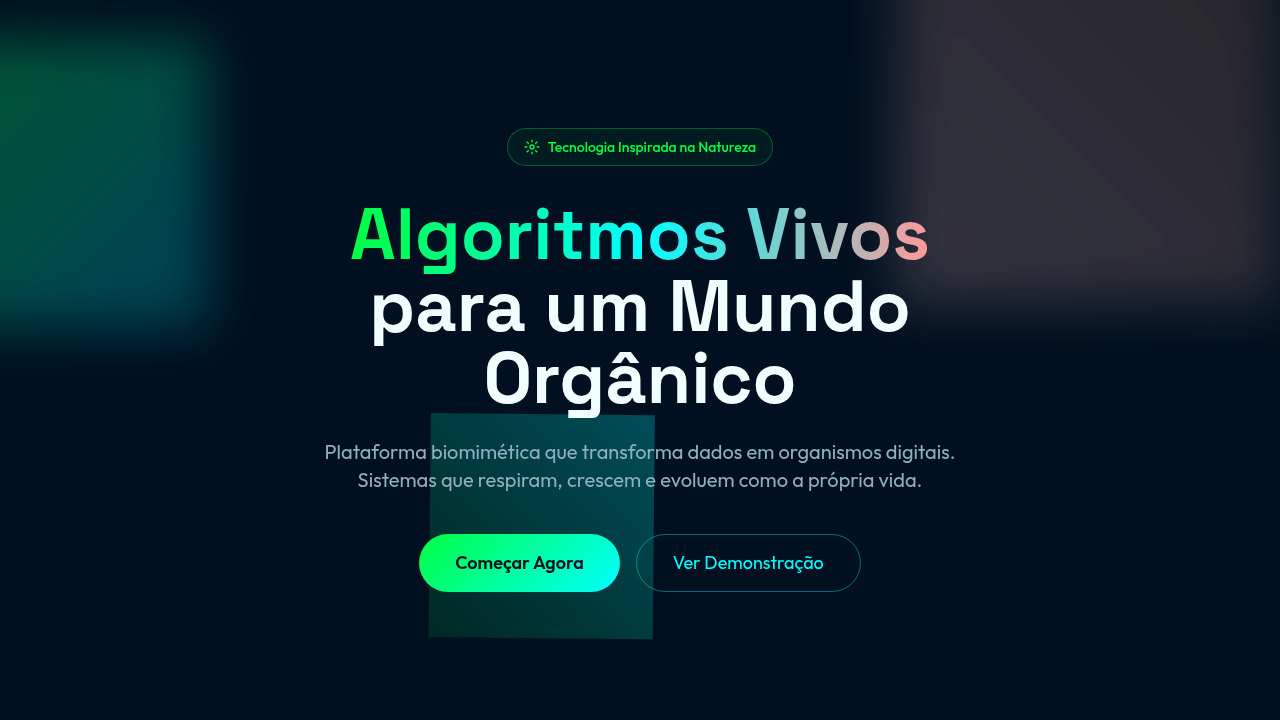
Biomimetic / Organic 2.0
Biomimetic organic interface. Ideal for landing pages, saas. AI-ready template.
Use case: Landing pages, SaaS
Historical Context
Designers have always stolen from nature. Buckminster Fuller's geodesic domes, Frei Otto's soap-film tensile structures, the Voronoi diagrams that showed up in everything from architecture to textile design — biomimicry isn't new. What changed is the tooling. Around 2018, creative coders started pushing p5.js and Three.js beyond demo reels into production interfaces. Reaction-diffusion patterns, L-systems, flocking algorithms — suddenly these weren't just generative art experiments. They were navigation systems, data visualizations, brand identities. The math that describes how cells divide or how slime mold finds the shortest path became a legitimate design language. Organic 2.0 is the maturation of that moment. It's not about slapping a leaf texture on a card component. It's algorithmic: growth patterns that respond to data, fluid simulations driven by user input, cellular structures that reorganize based on content density. The aesthetic emerges from rules, not decoration. Nature as system logic, not surface treatment.
When to Use
Reach for this when your product lives in the space between science and wonder. Biotech platforms explaining CRISPR to investors. Sustainability dashboards that need to feel alive without feeling frivolous. Generative art marketplaces. Research tools where the complexity of the subject demands an interface that breathes rather than grids everything into submission. Skip it for fintech, skip it for B2B SaaS dashboards — unless you want your CFO asking why the quarterly report is pulsating.
Design Principles
- Growth over placement — let elements emerge from algorithmic rules rather than fixed coordinates. Position is a result, not a decision.
- Imperfection is the point — embrace asymmetry, irregular edges, and organic variation. If every cell in your Voronoi grid is the same size, you've missed it entirely.
- Motion reveals structure — use animation to show how forms were generated. The process is the aesthetic. Static screenshots should feel like paused simulations.
- Data as nutrient — feed real information into your generative systems. The visualization should change shape when the underlying data changes, not just swap colors.
- Constraint breeds life — the most convincing organic systems come from simple rules applied recursively. Three parameters creating infinite variation beats fifty hand-tuned states.
DESIGN.md
---
version: "alpha"
name: "Biomimetic / Organic 2.0"
description: "Biomimetic organic interface. Ideal for landing pages, saas. AI-ready template."
colors:
  primary: "#FF9999"
  secondary: "#00FF41"
  tertiary: "#001E3C"
  neutral: "#FF7F50"
typography:
  h1:
    fontFamily: System UI stack
    fontSize: 2.25rem
    fontWeight: 700
  body-md:
    fontFamily: System UI stack
    fontSize: 1rem
    fontWeight: 400
  label-caps:
    fontFamily: System UI stack
    fontSize: 0.75rem
    fontWeight: 500
components:
  button-primary:
    backgroundColor: "{colors.primary}"
    textColor: "{colors.neutral}"
    padding: 12px
---

## Overview

Biomimetic organic interface. Ideal for landing pages, saas. AI-ready template. Designers have always stolen from nature. Buckminster Fuller's geodesic domes, Frei Otto's soap-film tensile structures, the Voronoi diagrams that showed up in everything from architecture to textile design — biomimicry isn't new. What changed is the tooling.

Around 2018, creative coders started pushing p5.js and Three.js beyond demo reels into production interfaces. Reaction-diffusion patterns, L-systems, flocking algorithms — suddenly these weren't just generative art experiments. They were navigation systems, data visualizations, brand identities. The math that describes how cells divide or how slime mold finds the shortest path became a legitimate design language.

Organic 2.0 is the maturation of that moment. It's not about slapping a leaf texture on a card component. It's algorithmic: growth patterns that respond to data, fluid simulations driven by user input, cellular structures that reorganize based on content density. The aesthetic emerges from rules, not decoration. Nature as system logic, not surface treatment.

- Density: 5/10 — Balanced
- Variance: 8/10 — Expressive
- Motion: 6/10 — Expressive

- **Style:** Organic, Generative, Natural, Flowing
- **Keywords:** Nature-inspired, cellular, fluid, breathing, generative, algorithms, life-like
- **Era:** 2024+ Generative
- **Light/Dark:** ✓ Full / ✓ Full

## Colors

- **Cellular Pink** (#FF9999) — Primary text color
- **Chlorophyll Green** (#00FF41) — Secondary surface or text color
- **Deep Ocean** (#001E3C) — Extended palette, decorative use
- **Coral** (#FF7F50) — Extended palette, decorative use


## Typography

- **Display / Hero:** System UI stack (-apple-system, sans-serif) — Weight 700, tight tracking, used for headline impact
- **Body:** System UI stack (-apple-system, sans-serif) — Weight 400, 16px/1.6 line-height, max 72ch per line
- **UI Labels / Captions:** System UI stack (-apple-system, sans-serif) — 0.875rem, weight 500, slight letter-spacing
- **Monospace:** JetBrains Mono — Used for code, metadata, and technical values

Scale:
- Hero: clamp(2.5rem, 5vw, 4rem)
- H1: 2.25rem
- H2: 1.5rem
- Body: 1rem / 1.6
- Small: 0.875rem


## Layout

- **Grid:** CSS Grid primary. Max-width containment: 1280px centered with 1.5rem side padding.
- **Spacing rhythm:** Balanced. Base unit: 0.5rem (8px).
- **Section vertical gaps:** clamp(4rem, 8vw, 8rem).
- **Hero layout:** Asymmetric composition.
- **Feature sections:** Asymmetric grid with varied card sizes. No 3-equal-columns.
- **Mobile collapse:** All multi-column layouts collapse below 768px. No horizontal overflow.
- **z-index contract:** base (0) / sticky-nav (100) / overlay (200) / modal (300) / toast (500).


## Elevation & Depth

Breathing animations, fluid morphing, generative growth, physics-based movement

- **Physics:** Spring — stiffness 120, damping 20. Confident, weighted transitions.
- **Entry animations:** Fade + translate-Y (16px → 0) over 480ms ease-out. Staggered cascades for lists: 100ms between items.
- **Hover states:** Scale(1.03) + shadow lift over 200ms.
- **Page transitions:** Fade + slide (300ms).
- **Performance:** Only transform and opacity animated. No layout-triggering properties.


## Shapes

Base corner radius: 9999px. See rounded tokens in front matter for the full scale.


## Components

- **Primary Button:** Pill-shaped (9999px) shape. Accent color fill. Hover: 8% darken + subtle lift shadow. Active: -1px translate tactile press. Font weight 600. No outer glows.
- **Secondary / Ghost Button:** Outline variant. 1.5px border in muted color. Text in primary color. Hover: subtle background fill.
- **Cards:** Pill-shaped (9999px) corners. Surface background. Subtle shadow (0 2px 12px rgba(0,0,0,0.06)). 1px border stroke.
- **Inputs:** Label above input. 1px border stroke. Focus ring: 2px accent color offset 2px. Error text below in semantic red. No floating labels.
- **Navigation:** Primary surface background. Active item: accent color indicator. Font weight 500 when active.
- **Skeletons:** Shimmer animation matching component dimensions. No circular spinners.
- **Empty States:** Icon-based composition with descriptive text and action button.


## Do's and Don'ts

- No emojis in UI — use icon system only (Lucide, Heroicons)
- No pure black (#000000) — use off-black or charcoal variants
- No oversaturated accent colors (saturation cap: 80%)
- No 3-column equal-width feature layouts — use zig-zag or asymmetric grid
- No `h-screen` — use `min-h-[100dvh]`
- No AI copywriting clichés: "Elevate", "Seamless", "Unleash", "Next-Gen"
- No broken external image links — use picsum.photos or inline SVG
- No generic lorem ipsum in demos

- Do Organic shapes present
- Do Animations feel alive
- Do Generative elements
- Do Performance monitored
- Do Mobile fallback
- Do Accessibility alt content


## Use Case

Landing pages, SaaS
Technical Specs
CSS
SVG morphing (SMIL or GSAP), canvas for generative, animation: breathing (scale pulse), filter: blur for organic, clip-path for cellular, WebGL for advanced, physics libraries
Variables
--cellular-pink: #FF9999, --chlorophyll: #00FF41, --bioluminescent: #00FFFF, --breathing-duration: 4s, --morph-ease: cubic-bezier(0.4, 0, 0.2, 1), --organic-blur: 20px
Checklist
☐ Organic shapes present, ☐ Animations feel alive, ☐ Generative elements, ☐ Performance monitored, ☐ Mobile fallback, ☐ Accessibility alt content
Colors
Primary
Secondary
Effects
Breathing animations, fluid morphing, generative growth, physics-based movement
Light/Dark
✓ Full / ✓ Full
AI Prompt
Act as a Senior Frontend Engineer and Expert UI Designer.
Your task is to code a complete Landing Page on the first attempt.
- Landing Page Theme: <INSERT THEME>
- Sections to add: <INSERT SECTIONS>

Generate the final code immediately following these definitions:

## Style

- **Name:** Biomimetic / Organic 2.0
- **Type:** Organic, Generative, Natural, Flowing
- **Keywords:** Nature-inspired, cellular, fluid, breathing, generative, algorithms, life-like
- **Era:** 2024+ Generative
- **Light/Dark:** ✓ Full / ✓ Full

## Color Palette

- **Primary:** Cellular Pink #FF9999, Chlorophyll Green #00FF41, Bioluminescent Blue
- **Secondary:** Deep Ocean #001E3C, Coral #FF7F50, Organic gradients

## Visual Effects

Breathing animations, fluid morphing, generative growth, physics-based movement

## AI Visual Direction

Design a biomimetic organic interface. Use: cellular/fluid shapes, breathing animations, generative patterns, bioluminescent colors, physics-based movement, nature algorithms, life-like elements, flowing gradients.

## CSS Technical

```css
SVG morphing (SMIL or GSAP), canvas for generative, animation: breathing (scale pulse), filter: blur for organic, clip-path for cellular, WebGL for advanced, physics libraries
```

## Design System Variables

```css
--cellular-pink: #FF9999, --chlorophyll: #00FF41, --bioluminescent: #00FFFF, --breathing-duration: 4s, --morph-ease: cubic-bezier(0.4, 0, 0.2, 1), --organic-blur: 20px
```

## Implementation Checklist

- ☐ Organic shapes present
- ☐ Animations feel alive
- ☐ Generative elements
- ☐ Performance monitored
- ☐ Mobile fallback
- ☐ Accessibility alt content

## Execution Rules

1. Strictly follow the defined visual style.
2. Use high-quality inline SVG icons (Heroicons or Lucide style) — NEVER use emojis as icons.
3. Add `cursor-pointer` and smooth `hover` states (transition-all) on all interactive elements.
4. Required Page Structure:
   - Navbar (Logo + Links + CTA)
   - Hero Section (Impactful Headline + Subtitle + 2 buttons + 3D/Abstract visual element via CSS)
   - Features (3 cards with icons)
   - Testimonials (3 cards)
   - Pricing (3 tiers, highlight the middle one)
   - Final CTA
   - Full Footer with social links, privacy policy, terms of use, contact and SEO links.
5. All text content must be in English.
6. The visual must be CLEARLY distinct — do not create a "default Bootstrap" design. Force the use of the provided design system variables.
7. Use `<style>` tags in the head for custom classes (especially for complex backdrop-filter effects and animations) that Tailwind CDN doesn't cover.
8. Full Responsiveness: Layout must adapt perfectly to Mobile, Tablet and Desktop (vertical stack on mobile).
9. Include basic SEO, Viewport and Open Graph meta tags in `<head>`.
10. Footer must contain: Copyright 2026, Secondary navigation links and Social media icons.
11. Make the creative decisions needed to deliver the complete, functional result now.
Related

Last synced: 4/1/2026