Democratized Fancy Animations
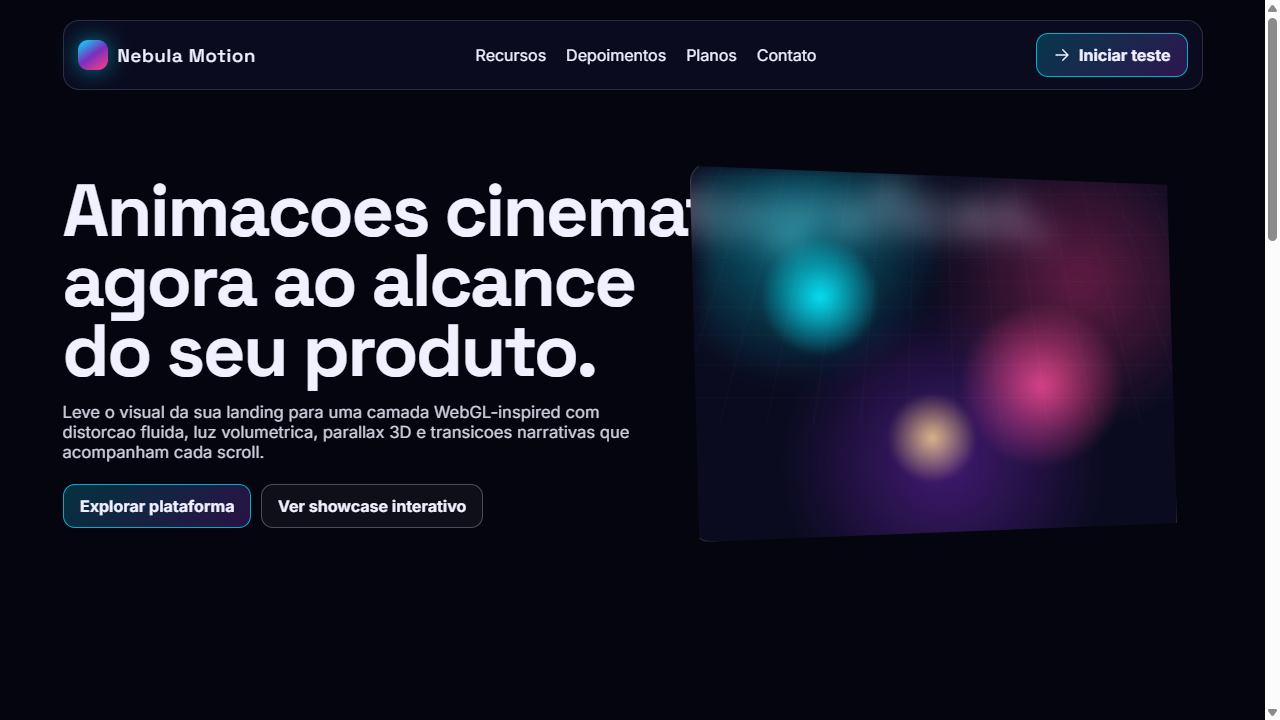
Visually stunning landing page with democratized fancy animations using CSS and lightweight WebGL-inspired effects. Ideal for landing pages premium, portfolios criativos, lancamentos de produto tech, agencias digitais, experiencias imersivas, showcases de design. AI-ready template.
Use case: Landing pages premium, Portfolios criativos, Lancamentos de produto tech, Agencias digitais, Experiencias imersivas, Showcases de design
Historical Context
For years, WebGL shader effects lived behind a wall of GLSL expertise and linear algebra. You either came from a demoscene background or you didn't touch it. The barrier wasn't creative — it was purely technical. Fragment shaders, vertex manipulation, render passes — this was territory reserved for graphics programmers, not designers who wanted a fluid distortion on their hero section. Then Three.js matured. OGL offered a lighter alternative. Shader playgrounds like The Book of Shaders and Shadertoy turned opaque GPU code into something you could poke at, remix, and learn from. Suddenly a frontend developer with curiosity could produce effects that previously required a dedicated WebGL engineer. Libraries like curtains.js and react-three-fiber collapsed the gap further — you could drop shader materials into a component tree. The democratization wasn't instant, but it was decisive. By 2023, fluid distortion, noise-driven meshes, and post-processing passes became viable design tools rather than engineering feats. The craft shifted from 'can we build this' to 'should we ship this' — a much healthier question.
When to Use
When the brand demands visceral, sensory-first storytelling that flat CSS cannot deliver. Portfolio sites where the work itself is visual. Creative agency homepages that need to signal technical ambition in the first 2 seconds. Brand experiences where the interaction IS the product — not decoration layered on top. Skip it for content-heavy pages, e-commerce flows, or anywhere cognitive load competes with conversion. The moment a shader effect makes someone wait or wonder where to click, you've lost the plot.
Design Principles
- Performance is a design constraint, not an engineering afterthought — target 60fps or kill the effect entirely
- Shader complexity should serve narrative; fluid distortion without conceptual purpose is just a screensaver
- Degrade gracefully — the experience must remain coherent on devices that can't run WebGL, not just show a blank canvas
- Restrain the viewport footprint; full-screen shader takeovers fatigue users faster than designers expect
- Tie animation intensity to user interaction — idle states should breathe, not scream
DESIGN.md
---
version: "alpha"
name: "Democratized Fancy Animations"
description: "Visually stunning landing page with democratized fancy animations using CSS and lightweight WebGL-inspired effects. Ideal for landing pages premium, portfolios criativos, lancamentos de produto tech, agencias digitais, experiencias imersivas, showcases de design. AI-ready template."
colors:
  primary: "#050510"
  secondary: "#1a1a4e"
  tertiary: "#F0F0FF"
  neutral: "#7B2FBE"
  surface: "#00E5FF"
  accent: "#FF4081"
typography:
  h1:
    fontFamily: Space Grotesk
    fontSize: 2.25rem
    fontWeight: 700
  body-md:
    fontFamily: Inter
    fontSize: 1rem
    fontWeight: 400
  label-caps:
    fontFamily: Inter
    fontSize: 0.75rem
    fontWeight: 500
components:
  button-primary:
    backgroundColor: "{colors.primary}"
    textColor: "{colors.neutral}"
    padding: 12px
---

## Overview

Visually stunning landing page with democratized fancy animations using CSS and lightweight WebGL-inspired effects. Ideal for landing pages premium, portfolios criativos, lancamentos de produto tech, agencias digitais, experiencias imersivas, showcases de design. AI-ready template. For years, WebGL shader effects lived behind a wall of GLSL expertise and linear algebra. You either came from a demoscene background or you didn't touch it. The barrier wasn't creative — it was purely technical. Fragment shaders, vertex manipulation, render passes — this was territory reserved for graphics programmers, not designers who wanted a fluid distortion on their hero section.

Then Three.js matured. OGL offered a lighter alternative. Shader playgrounds like The Book of Shaders and Shadertoy turned opaque GPU code into something you could poke at, remix, and learn from. Suddenly a frontend developer with curiosity could produce effects that previously required a dedicated WebGL engineer. Libraries like curtains.js and react-three-fiber collapsed the gap further — you could drop shader materials into a component tree.

The democratization wasn't instant, but it was decisive. By 2023, fluid distortion, noise-driven meshes, and post-processing passes became viable design tools rather than engineering feats. The craft shifted from 'can we build this' to 'should we ship this' — a much healthier question.

- Density: 5/10 — Balanced
- Variance: 4/10 — Moderate
- Motion: 8/10 — Cinematic

- **Style:** WebGL, Shader-Driven, Fluid Distortion, Interactive 3D, Story-Driven Motion
- **Keywords:** WebGL, shaders, fluid distortion, volumetric light, chromatic aberration, particle physics, blob tracking, Spline, Rive, interactive 3D, story-driven motion, 120fps, lightweight engine, mouse-reactive
- **Era:** 2025-2026 WebGL Democratized
- **Light/Dark:** ✗ None / ✓ Full

## Colors

- **Preto Profundo** (#050510) — Primary background surface
- **Azul Cosmico** (#1a1a4e) — Accent highlight, links and focus states
- **Branco Luminoso** (#F0F0FF) — Light surface, card backgrounds
- **Roxo Shader** (#7B2FBE) — Accent color, emphasis elements
- **Ciano Glow** (#00E5FF) — Extended palette, decorative use
- **Rosa Plasma** (#FF4081) — Decorative accent, highlight elements
- **Dourado Particula** (#FFD54F) — Premium accent, decorative highlights


## Typography

- **Display / Hero:** Space Grotesk — Weight 700, tight tracking, used for headline impact
- **Accent:** Inter — Used for decorative or emphasis text
- **Body:** Space Grotesk — Weight 400, 16px/1.6 line-height, max 72ch per line
- **UI Labels / Captions:** Space Grotesk — 0.875rem, weight 500, slight letter-spacing
- **Monospace:** JetBrains Mono — Used for code, metadata, and technical values

Scale:
- Hero: clamp(2.5rem, 5vw, 4rem)
- H1: 2.25rem
- H2: 1.5rem
- Body: 1rem / 1.6
- Small: 0.875rem


## Layout

- **Grid:** CSS Grid primary. Max-width containment: 1280px centered with 1.5rem side padding.
- **Spacing rhythm:** Balanced. Base unit: 0.5rem (8px).
- **Section vertical gaps:** clamp(4rem, 8vw, 8rem).
- **Hero layout:** Split-screen (text left, visual right).
- **Feature sections:** Zig-zag alternating text+image rows. No 3-equal-columns.
- **Mobile collapse:** All multi-column layouts collapse below 768px. No horizontal overflow.
- **z-index contract:** base (0) / sticky-nav (100) / overlay (200) / modal (300) / toast (500).


## Elevation & Depth

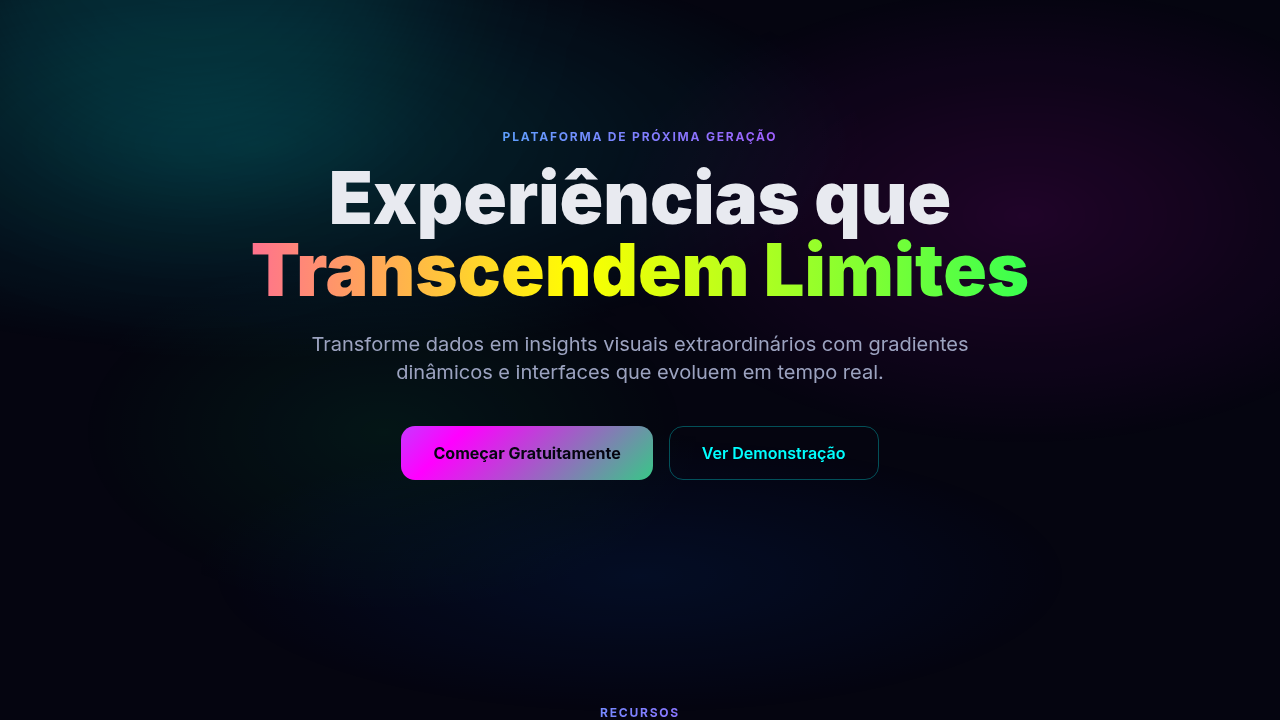
Elementos reagindo ao usuario em tempo real via shaders e WebGL: distorcoes de fluidos no fundo, luzes volumetricas com profundidade, brilhos baseados em profundidade, aberracoes cromaticas sutis, simulacoes fisicas (gravidade e colisao de particulas) leves (~29kb engine), blob tracking seguindo o mouse, transicoes de secao com morphing fluido, parallax 3D reativo ao cursor

- **Physics:** Spring — stiffness 120, damping 20. Confident, weighted transitions.
- **Entry animations:** Fade + translate-Y (16px → 0) over 540ms ease-out. Staggered cascades for lists: 120ms between items.
- **Hover states:** Scale(1.03) + shadow lift over 200ms.
- **Page transitions:** Fade + slide (300ms).
- **Performance:** Only transform and opacity animated. No layout-triggering properties.


## Shapes

Base corner radius: 8px. See rounded tokens in front matter for the full scale.


## Components

- **Primary Button:** Subtly rounded (0.5rem) shape. Accent color fill. Hover: 8% darken + subtle lift shadow. Active: -1px translate tactile press. Font weight 600. No outer glows.
- **Secondary / Ghost Button:** Outline variant. 1.5px border in muted color. Text in primary color. Hover: subtle background fill.
- **Cards:** Subtly rounded (0.5rem) corners. Surface background. Subtle shadow (0 2px 12px rgba(0,0,0,0.06)). 1px border stroke.
- **Inputs:** Label above input. 1px border stroke. Focus ring: 2px accent color offset 2px. Error text below in semantic red. No floating labels.
- **Navigation:** Primary surface background. Active item: accent color indicator. Font weight 500 when active.
- **Skeletons:** Shimmer animation matching component dimensions. No circular spinners.
- **Empty States:** Icon-based composition with descriptive text and action button.


## Do's and Don'ts

- No emojis in UI — use icon system only (Lucide, Heroicons)
- No pure black (#000000) — use off-black or charcoal variants
- No oversaturated accent colors (saturation cap: 80%)
- No 3-column equal-width feature layouts — use zig-zag or asymmetric grid
- No `h-screen` — use `min-h-[100dvh]`
- No AI copywriting clichés: "Elevate", "Seamless", "Unleash", "Next-Gen"
- No broken external image links — use picsum.photos or inline SVG
- No generic lorem ipsum in demos

- Do Fundo cosmico escuro com efeito fluido SVG
- Do Luzes volumetricas com radial-gradient animado
- Do Aberracao cromatica no hover de titulos
- Do Particulas flutuantes com CSS keyframes
- Do Blob gradient seguindo o mouse
- Do Transicoes de secao com clip-path morphing
- Do Parallax reativo ao cursor
- Do GPU-accelerated com will-change e translate3d
- Do Animacoes narrativas no scroll


## Use Case

Landing pages premium, Portfolios criativos, Lancamentos de produto tech, Agencias digitais, Experiencias imersivas, Showcases de design
Technical Specs
CSS
background: #050510; filter: url(#turbulence) for fluid effect; SVG feTurbulence + feDisplacementMap; text-shadow: -2px 0 #FF4081, 2px 0 #00E5FF for chromatic aberration; radial-gradient layers for volumetric light; @keyframes float with random animation-delay; clip-path: polygon() animated for morphing; transform: translate3d(var(--mx), var(--my), 0) for parallax; will-change: transform; transition: all 600ms cubic-bezier(0.23, 1, 0.32, 1)
Variables
--bg-cosmic: #050510; --bg-deep: #1a1a4e; --color-text: #F0F0FF; --glow-purple: #7B2FBE; --glow-cyan: #00E5FF; --glow-pink: #FF4081; --glow-gold: #FFD54F; --transition-fluid: 600ms cubic-bezier(0.23, 1, 0.32, 1); --parallax-intensity: 20px; --blur-glow: 40px; --particle-count: 20; --font-display: 'Space Grotesk', sans-serif; --font-body: 'Inter', sans-serif
Checklist
☐ Fundo cosmico escuro com efeito fluido SVG, ☐ Luzes volumetricas com radial-gradient animado, ☐ Aberracao cromatica no hover de titulos, ☐ Particulas flutuantes com CSS keyframes, ☐ Blob gradient seguindo o mouse, ☐ Transicoes de secao com clip-path morphing, ☐ Parallax reativo ao cursor, ☐ GPU-accelerated com will-change e translate3d, ☐ Animacoes narrativas no scroll
Colors
Primary
Secondary
Effects
Elementos reagindo ao usuario em tempo real via shaders e WebGL: distorcoes de fluidos no fundo, luzes volumetricas com profundidade, brilhos baseados em profundidade, aberracoes cromaticas sutis, simulacoes fisicas (gravidade e colisao de particulas) leves (~29kb engine), blob tracking seguindo o mouse, transicoes de secao com morphing fluido, parallax 3D reativo ao cursor
Light/Dark
✗ None / ✓ Full
AI Prompt
Act as a Senior Frontend Engineer and Expert UI Designer.
Your task is to code a complete Landing Page on the first attempt.
- Landing Page Theme: <INSERT THEME>
- Sections to add: <INSERT SECTIONS>

Generate the final code immediately following these definitions:

## Style

- **Name:** Democratized Fancy Animations
- **Type:** WebGL, Shader-Driven, Fluid Distortion, Interactive 3D, Story-Driven Motion
- **Keywords:** WebGL, shaders, fluid distortion, volumetric light, chromatic aberration, particle physics, blob tracking, Spline, Rive, interactive 3D, story-driven motion, 120fps, lightweight engine, mouse-reactive
- **Era:** 2025-2026 WebGL Democratized
- **Light/Dark:** ✗ None / ✓ Full

## Color Palette

- **Primary:** Preto Profundo #050510, Azul Cosmico #1a1a4e, Branco Luminoso #F0F0FF
- **Secondary:** Roxo Shader #7B2FBE, Ciano Glow #00E5FF, Rosa Plasma #FF4081, Dourado Particula #FFD54F

## Visual Effects

Elementos reagindo ao usuario em tempo real via shaders e WebGL: distorcoes de fluidos no fundo, luzes volumetricas com profundidade, brilhos baseados em profundidade, aberracoes cromaticas sutis, simulacoes fisicas (gravidade e colisao de particulas) leves (~29kb engine), blob tracking seguindo o mouse, transicoes de secao com morphing fluido, parallax 3D reativo ao cursor

## AI Visual Direction

Design a visually stunning landing page with democratized fancy animations using CSS and lightweight WebGL-inspired effects. Create fluid distortion backgrounds using CSS filters and SVG turbulence (feTurbulence + feDisplacementMap). Volumetric light effects with radial-gradient layers and animation. Chromatic aberration on hover using text-shadow with RGB offset. Particle-like floating elements using CSS @keyframes with random delays and positions. Blob tracking effect — a soft gradient circle that follows mouse position via CSS custom properties updated by minimal JS (mousemove event). Section transitions with smooth morphing shapes (clip-path animations). Parallax depth layers reacting to cursor position. Use dark cosmic background (#050510) with glowing accent colors (cyan #00E5FF, purple #7B2FBE, pink #FF4081). All animations should feel fluid at 60fps with will-change and transform: translate3d for GPU acceleration. Story-driven motion — each scroll reveals content with purposeful choreographed animation.

## CSS Technical

```css
background: #050510; filter: url(#turbulence) for fluid effect; SVG feTurbulence + feDisplacementMap; text-shadow: -2px 0 #FF4081, 2px 0 #00E5FF for chromatic aberration; radial-gradient layers for volumetric light; @keyframes float with random animation-delay; clip-path: polygon() animated for morphing; transform: translate3d(var(--mx), var(--my), 0) for parallax; will-change: transform; transition: all 600ms cubic-bezier(0.23, 1, 0.32, 1)
```

## Design System Variables

```css
--bg-cosmic: #050510; --bg-deep: #1a1a4e; --color-text: #F0F0FF; --glow-purple: #7B2FBE; --glow-cyan: #00E5FF; --glow-pink: #FF4081; --glow-gold: #FFD54F; --transition-fluid: 600ms cubic-bezier(0.23, 1, 0.32, 1); --parallax-intensity: 20px; --blur-glow: 40px; --particle-count: 20; --font-display: 'Space Grotesk', sans-serif; --font-body: 'Inter', sans-serif
```

## Implementation Checklist

- ☐ Fundo cosmico escuro com efeito fluido SVG
- ☐ Luzes volumetricas com radial-gradient animado
- ☐ Aberracao cromatica no hover de titulos
- ☐ Particulas flutuantes com CSS keyframes
- ☐ Blob gradient seguindo o mouse
- ☐ Transicoes de secao com clip-path morphing
- ☐ Parallax reativo ao cursor
- ☐ GPU-accelerated com will-change e translate3d
- ☐ Animacoes narrativas no scroll

## Execution Rules

1. Strictly follow the defined visual style.
2. Use high-quality inline SVG icons (Heroicons or Lucide style) — NEVER use emojis as icons.
3. Add `cursor-pointer` and smooth `hover` states (transition-all) on all interactive elements.
4. Required Page Structure:
   - Navbar (Logo + Links + CTA)
   - Hero Section (Impactful Headline + Subtitle + 2 buttons + 3D/Abstract visual element via CSS)
   - Features (3 cards with icons)
   - Testimonials (3 cards)
   - Pricing (3 tiers, highlight the middle one)
   - Final CTA
   - Full Footer with social links, privacy policy, terms of use, contact and SEO links.
5. All text content must be in English.
6. The visual must be CLEARLY distinct — do not create a "default Bootstrap" design. Force the use of the provided design system variables.
7. Use `<style>` tags in the head for custom classes (especially for complex backdrop-filter effects and animations) that Tailwind CDN doesn't cover.
8. Full Responsiveness: Layout must adapt perfectly to Mobile, Tablet and Desktop (vertical stack on mobile).
9. Include basic SEO, Viewport and Open Graph meta tags in `<head>`.
10. Footer must contain: Copyright 2026, Secondary navigation links and Social media icons.
11. Make the creative decisions needed to deliver the complete, functional result now.
Related
Last synced: 4/1/2026